Domain Cleanup
Most portfolios hold years of campaign sites, market domains and defensive registrations nobody has looked at since they were bought. Domain Cleanup puts each one in front of the person who can decide, with a suggestion and a reason.
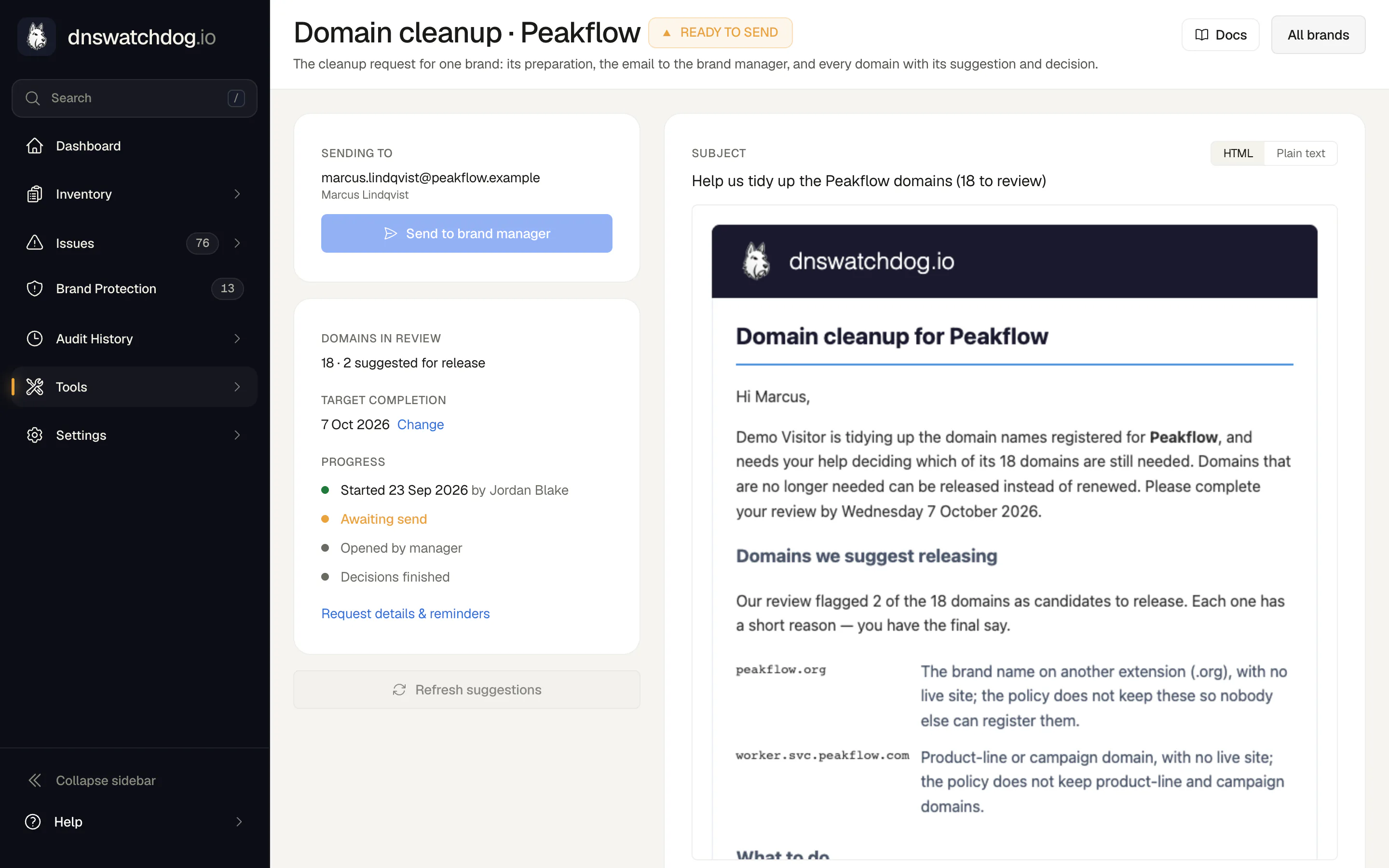
The team that runs DNS rarely decides what a brand registers. That is the brand manager's call, and asking them domain by domain over email and spreadsheets is why old portfolios never shrink. Each domain renews every year, carries DNS records someone has to keep safe, and often belongs to a campaign or market that ended long ago.
DNS Watchdog already knows each domain: when it was registered, whether it serves a live site, and what it is to its brand, from the primary domain and market domains to campaign sites and misspellings held as protection. A short, documented decision tree turns those facts and your domain policy into a keep or release suggestion with a one-line reason. The suggestion is not made by AI, and changing a policy switch updates every suggestion at once.
You send each brand manager their review in one click. They sign in straight from the email, see a screenshot of every live site, and mark each domain keep or release, with room to say why. Reminders go out automatically until they finish, and every step lands in an audit log. The domains they release are collected in one list to take to your registrar. Nothing is released automatically.
How it works
- GatherRegistration dates, live-site checks and screenshots are collected for every domain in a brand, and each domain is classified by what it is to the brand.
- SuggestA decision tree applies your domain policy and suggests keep or release for each domain, naming the rule behind it.
- SendThe brand manager receives an email listing the domains suggested for release, and signs in straight to their review.
- DecideThey mark each domain keep or release and can leave feedback. Reminders go out every three days until the review is finished.
- ReleaseReleased domains are collected in one list, with who released them and when, ready for your registrar.
What you get
- A keep or release suggestion for every domain in a brand, each with its reason
- Registration date, live-site status and a screenshot for every domain
- Domain policy switches for campaign, market, defensive and novelty-TLD domains
- A Brand Manager role that sees their review and nothing else
- Automatic reminders, a target completion date and overdue flags
- A full audit log, and one list of released domains for your registrar
Why it matters
Renewals you can justify
Every domain you keep has a named owner who chose to keep it, and every one you drop has a recorded reason.
Decisions from the people who own them
Brand managers decide on a single page built for them, without learning a DNS tool or working through a spreadsheet.
A smaller estate to secure
Fewer domains means fewer zones and records to monitor, and fewer forgotten names pointing at infrastructure nobody remembers.
Policy, not guesswork
Suggestions follow rules you set, such as keeping market domains where you operate, so two domains with the same facts always get the same answer.
FAQ
Does DNS Watchdog release or transfer domains?
No. It is read-only. It collects each brand manager's decisions and gives you the list of released domains to act on at your registrar.
Is the suggestion made by AI?
No. AI classifies what each domain is to its brand when the brand is inferred. The keep or release suggestion is a short decision tree over that classification, the domain's extension, whether it has a live site and your domain policy, so it is predictable and every suggestion names its rule.
Can it tell which domains get traffic?
No. DNS Watchdog has no traffic data and the suggestions never cite any. Whether a domain has a live site comes from the HTTP scan of its records.